
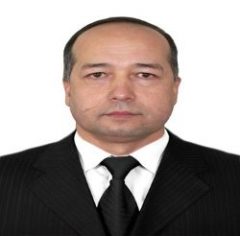
Mamatqulov Shavkat Israilovich
Main Scientific Directions:
- Developing technology for nanoscale catalysts production based on transition metals and their oxides (on a substrate of anodic alumina (AAO), titanium dioxide, etc.), as well as the study of their properties leading to the manifestation of features in catalytic activity;
- Studying the mechanism of nucleation and growth of metal nanoparticles, determining the condition for controlling their size and shape on a nanometer scale;
- Identifying the patterns of nanoparticle formation with a size of 10-100 nm, the influence of various factors on the morphology, structure and stability of the particles, as well as on the physico-chemical and operational properties of nanoscale composites with desired properties;
- Creating perspective nanomaterials and nanocomposites, electrochemical restoration of bioactive nanocoatings on biotechnology implants, materials and composites with surface-active properties, etc.
Main results:
- Nanostructured catalysts based on anodic aluminum oxide (AAO) and 3d metals, such as: nickel, cobalt, and molybdenum, have been obtained by anodic oxidation and impregnation. The activity of nickel and heterogenic cobalt and molybdenum nanoparticles are tested in the reaction of hydrogenation of hexene to hexane. The results show that the yield temperature of the hexane is decreased and the yield of hexane is observed at 200 °C with Ni/AAO catalysts, and a similar yield of hexane mass is achieved at temperatures higher than 250 °C with Co-Mo/AAO and traditional nickel catalysts on kieselguhr;
- The presence of ions affects the structure and dynamics of water on a multitude of length and time scales. In this context, pairs of Mg2+ and SO42− ions in water constitute a prototypical system for which conflicting pictures of hydration geometries and dynamics have been reported. combined experimental and theoretical study reveals a cooperative slow-down of water dynamics around solvent-separated pairs of sulfate and magnesium ions. This slow-down is evident from a significant reduction of spectral diffusion of asymmetric sulfate stretching excitations, which is benchmarked by a direct comparison to the femtosecond spectral diffusion observed in aqueous Na2SO4.;
- A three-dimensional numerical model of the system configurations of various types of solid oxide fuel cells (SOFCs) was built and the effect of parameters on SOFC performance was numerically investigated using COMSOL Multiphysics.
contact details
+998 71 235 4061